-(2).svg)
.svg)
April marks Stress Awareness Month, an annual event dedicated to increasing public awareness about the causes, effects, and management of stress. So, let’s talk about it.

According to a 2025 report from the Chartered Institute of Building (CIOB), 94% of tradespeople reported experiencing stress, 83% experienced anxiety, while 60% experienced depression in the past year. According to the findings, this led to symptoms such as fatigue (90%), poor concentration (86%), feelings of overwhelm (82%) and suicidal thoughts (27%).
These figures are troubling, and not just for their scale; fatigue and distraction can naturally increase the risk of errors in a safety-critical industry like ours. When people are tired or overwhelmed, it’s simply harder for anyone to stay fully focused, which may lead to unintended mistakes.
Moreover, research from YouGov also shows that 62% of tradespeople don't think we discuss mental health challenges enough as a society, making them 29% more likely than the general population to feel mental health is a hidden issue.
Breaking the silence
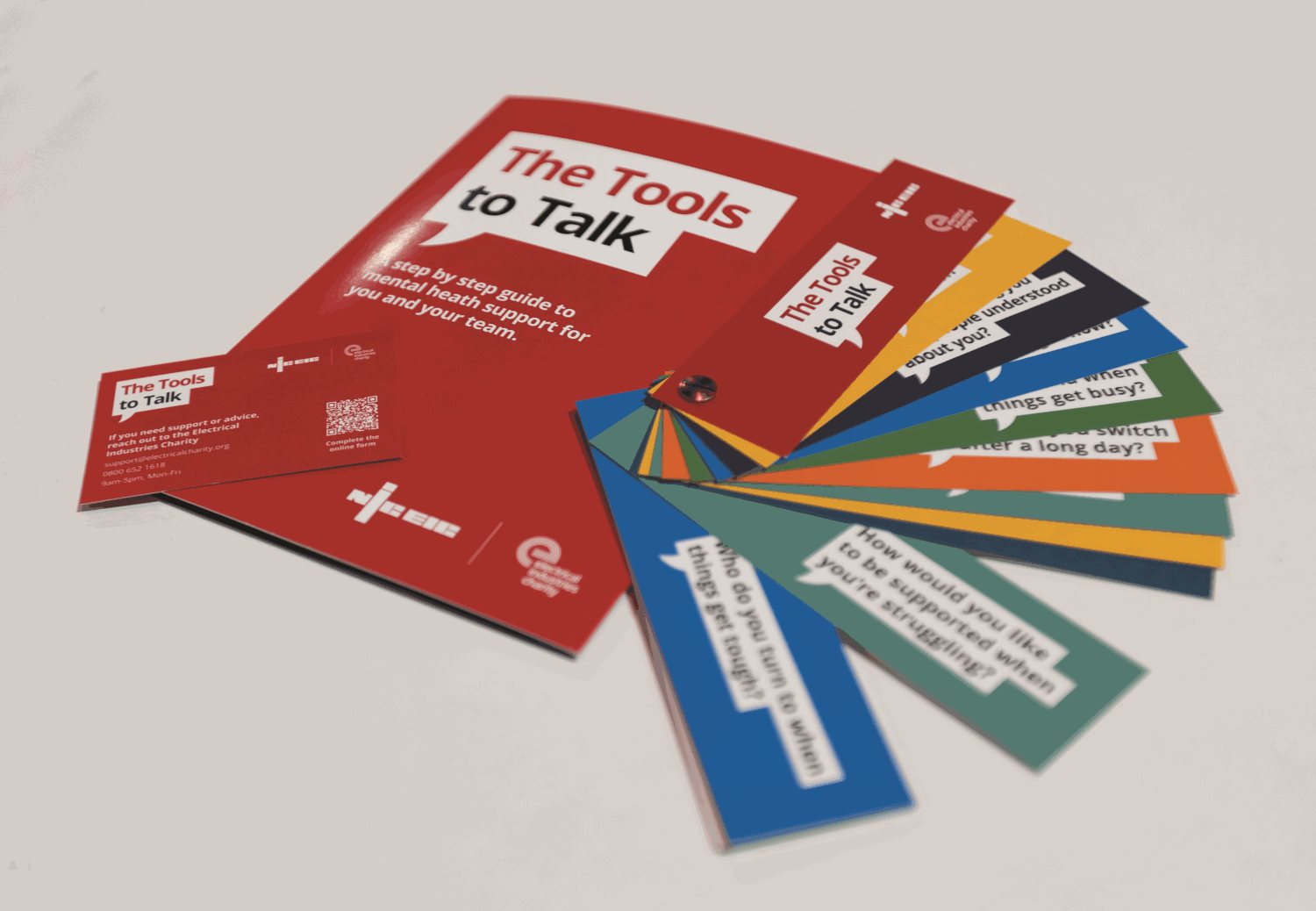
Something clearly needs to change, and everyone who works in our industry needs to play their role in creating that change. That’s why NICEIC has teamed up with the Electrical Industries Charity (EIC) to create The Tools to Talk – the mental health toolkit designed exclusively for NICEIC-certified businesses.
Changing the industry culture starts with opening up conversations, whether that’s on a job, on site, or just chatting with our teams, colleagues, and friends. The Tools to Talk provides advice, guidance, and conversation starters to help you open up those all-important conversations. We’ll talk about the toolkit more later in this article.
Starting a conversation can be daunting, so having a clear, simple framework to follow can give you confidence. Following the ‘ALSS’ model – Ask, Listen, Support, Signpost – will help you open the conversation and continue it in a supportive way.
ASK: How can I begin a conversation about mental health?
Don’t wait for the ‘perfect moment’; you can start small by simply asking: “How are you doing?” or “What’s going on with you?” But these are basic questions, and it’s all too easy for people to brush them off and say, “I’m fine, thanks”, out of habit or because they’re answering on auto-pilot.
We all know that when people say they’re “fine,” it doesn’t always mean they actually are. So instead of asking once and moving on, take a moment to show that you genuinely care. Ask twice, give them a second chance to open up. If someone replies, “Yeah, I’m good, thanks,” try gently following up with something like, “Are you sure? I’ve noticed you seem a bit distracted lately, how are things really going?” or “How are you really doing? I know you’ve got a lot on right now.” Sometimes, that second question makes all the difference – it shows you’re paying attention, and that you’re there to listen if they’re ready to talk.
People often worry that if they ask someone how they’re doing, it might make things worse. But this is rarely the case in practice. Most of the time, the main thing we all need is just for someone to give us some time to listen, and to hold space for us.
LISTEN: How can I be a good listener when talking about mental health?
Listening to understand, rather than listening to respond, is key. Don’t underestimate the value of listening.
It’s all about creating a relationship and building a connection. If you form a connection with someone, it builds trust naturally and that trust comes from actively listening to understand, rather than listening to respond.
When someone has disclosed they’re struggling, it’s important to bring understanding and empathy to the conversation and give it the time it requires. But they don’t need you to try to fix things for them or to respond with all the answers.
You don’t need to be an expert; just be present and supportive, and hold space for them.
SUPPORT: How can I offer support during conversations about mental health?
As the conversation progresses, think about:
- encouraging connection
- showing empathy
- having relaxed body language
- asking open questions
- giving your full attention and time
- remembering that you don’t have or need all the answers.
It’s also important to be mindful of the language you’re using. Some of things you might say to be supportive include: “I can hear this feels really overwhelming right now” or “You’ve been coping with a lot; thank you for telling me”. But try to avoid phrases such as “Calm down” or “You shouldn’t feel like that”.
The examples below can help you think about other helpful phrases to use versus unhelpful phrases to avoid:
 |
“That sounds really difficult; let’s take this one step at a time.” |  |
"It’s not that bad.” |
|
“You’re not alone, I’m here with you right now.” | |
“I know exactly how you feel.” |
|
"Would you like me to stay with you while we get some help?” | |
“You’ll be fine.” |
|
“It sounds like things feel really heavy right now; can you tell me a bit more?” | |
“Try to think positive.” |
|
“You’ve done the right thing by talking about this.” | |
“Don’t talk like that.” |
SIGNPOST: Where can I find further mental health support and resources?
There are plenty of resources you can access to help support yourself and others. Our industry is fortunate in having the Electrical Industries Charity (EIC), which offers a wealth of guidance, advice and support, not only to individuals but to their households and families.
The Tools To Talk, a joint collaboration between NICEIC and the EIC, can be accessed by all NICEIC-certified businesses and includes:
- handy conversation starters and self-reflection prompts
- a booklet and leaflet containing practical advice on spotting the signs of poor mental health and supporting people
- a quarterly newsletter packed with tips for supporting yourself and your team and keeping mental wellbeing in the spotlight
- mental health webinar episodes tackling a wide range of topics related to mental health, stress, and wellbeing.
Visit our dedicated webpage to find out more about The Tools to Talk.
Other resources include:
- Hub of hope, allows you to search for support organisations in your area.
- Samaritans, offer confidential emotional support to anyone in distress, struggling to cope, or at risk of suicide, available 24 hours a day via phone, email, or online chat.
- CALM (Campaign Against Living Miserably).
- Shout, a free, confidential, 24/7 text service for anyone struggling to cope. Text "SHOUT" to 85258.
- The Mix, offer support for young people in the UK.
- Mind, provide advice and support for anyone experiencing mental health challenges.
- NHS Mental Health Services.
What else can we do, as businesses and individuals, to build a more supportive culture?
Everyone has a role to play in creating environments where people feel safe to open up and ask for support. Here are some ideas to try in your workplace:
- share your own story, giving others permission to do the same
- lead by example: take breaks, check in, and show care
- make mental health part of regular team conversations
- recognise that a supportive culture starts at the top.




 Find out more about The Tools to Talk and start productive conversations with your team.